Darnley Grist Mill
Description
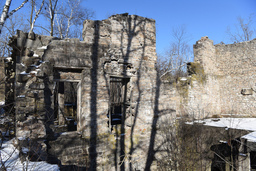
Many early settlers along Spencer Creek were United Empire Loyalists, fleeing the United States after the American Revolution. A Scotsman, James Crooks, founded the community of Crooks Hollow circa 1805. He completed construction of his grist mill in 1813 and named it after Lord Darnley, whom he claimed as an ancestor. It was built of stone from a quarry near Morden's Mills downstream. The original building was three storeys.
Power was provided by a 9m high overshot wheel mounted on the outside wall be Spencer Creek. When visiting the cascade, the trail crosses the remains of the headrace.
In 1829, the mill was expanded to include a distillery, a linseed oil mill, a cooperage, a clothing factory, a fulling and drying works, a tannery, a woollen mill, a foundry, an agricultural implement factory and Upper Canada's first paper mill. The community also expanded to include a general store and inn.
Following Crooks' death in 1860, the grist mill was sold to James Stutt and Robert Sanderson, who converted it to a paper mill. In 1880, Stutt bought out Sanderson's stake in the mill and added a steam boiler as an alternate power source and for heating water for paper making. On July 9th, 1885, the boiler exploded killing two men and causing considerable damage to the mill.
In 1943 the mill was gutted by fire and left in ruins.
Media
| Location | 80°0'23.317"W 43°16'35.904"N |
| Park | Crooks Hollow Conservation Area |
| Type | Historic Ruins |
| Authority / Owner | Hamilton Conservation Authority |